Introduction
More and more drone pilots hear the term Remote ID, but few know exactly what it means. Since 2024, a Remote ID beacon has become essential: a small module that acts as the digital license plate of your drone. In this article we explain how such a beacon works and why it is also the solution for older drones.
What is a Remote ID beacon?
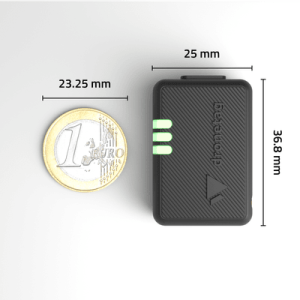
A Remote ID beacon is a lightweight transmitter that you easily attach to your drone. The device continuously broadcasts important data via Bluetooth, such as:
- your operator ID (the official registration number of the pilot),
- the position and altitude of the drone,
- the position of the pilot.
This allows anyone with the right app or scanner to immediately see who is flying and where.
How does it work in practice?
The beacon is completely stand-alone:
- it has a built-in GPS antenna to determine its position,
- a built-in rechargeable battery (lasting 8–16 hours) that you recharge via USB-C,
- a simple mounting system with Velcro or tape so you can attach it to almost any drone.
You don’t need to modify your drone: the beacon does all the work itself.
Example: the Dronetag Beacon
One of the most popular models is the Dronetag Beacon:
- weight: only 16 grams,
- battery life: up to 16 hours,
- user-friendly: settings via an app on your smartphone,
- compliant with EU standards, fully legally approved.
Thanks to the built-in GNSS receiver you don’t need extra antennas or cabling.
Continue reading “Remote ID Beacon: the digital license plate for your drone”
 Preparation: clarity from the start
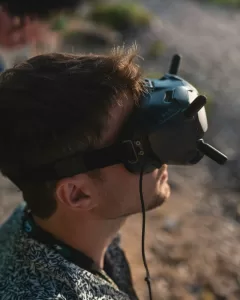 FPV stands for First Person View and means that, as a drone pilot, you receive live images directly from the drone’s camera. In the early days, this usually happened via an analog video link, with a small transmitter on the drone and a receiver built into the goggles or monitor. This way, you experience the flight as if you are inside the drone – something drone enthusiasts describe as a unique, almost bird-like sensation. Although technology has advanced enormously since then, the core feeling remains the same: flying in real time through the eyes of your aircraft.